Information

Peer Review Process Policy

1. Each manuscript is reviewed by at least two experts.

2. Reviewers should not be affiliated with the same institution as the authors, nor should they have close personal or professional ties.

3. A double-blind review mechanism is employed (both reviewers’ and authors’ identities are kept confidential).

4. Interdisciplinary manuscripts are reviewed by experts from different fields.

Selection of Reviewers Policy

1. The selection of reviewers is comprehensively evaluated based on the journal's dynamic reviewer database, references from the submitted manuscript, and literature retrieval platforms.

2. Reviewers are selected according to the keywords or main terms of the submitted manuscript to ensure alignment with the research field.

3. The academic qualifications of reviewers are primarily assessed based on their publications in authoritative journals in China and other countries, as well as their academic influence.

4. The reliability of reviewers is determined by their conscientiousness in review tasks and their ability to provide feedback within the review cycle.

5. The availability of sufficient time and energy from reviewers is an important consideration for the editorial department.

6. Peer experts who could potentially identify the authors based on the manuscript’s content are excluded from the pool of potential reviewers for that article.

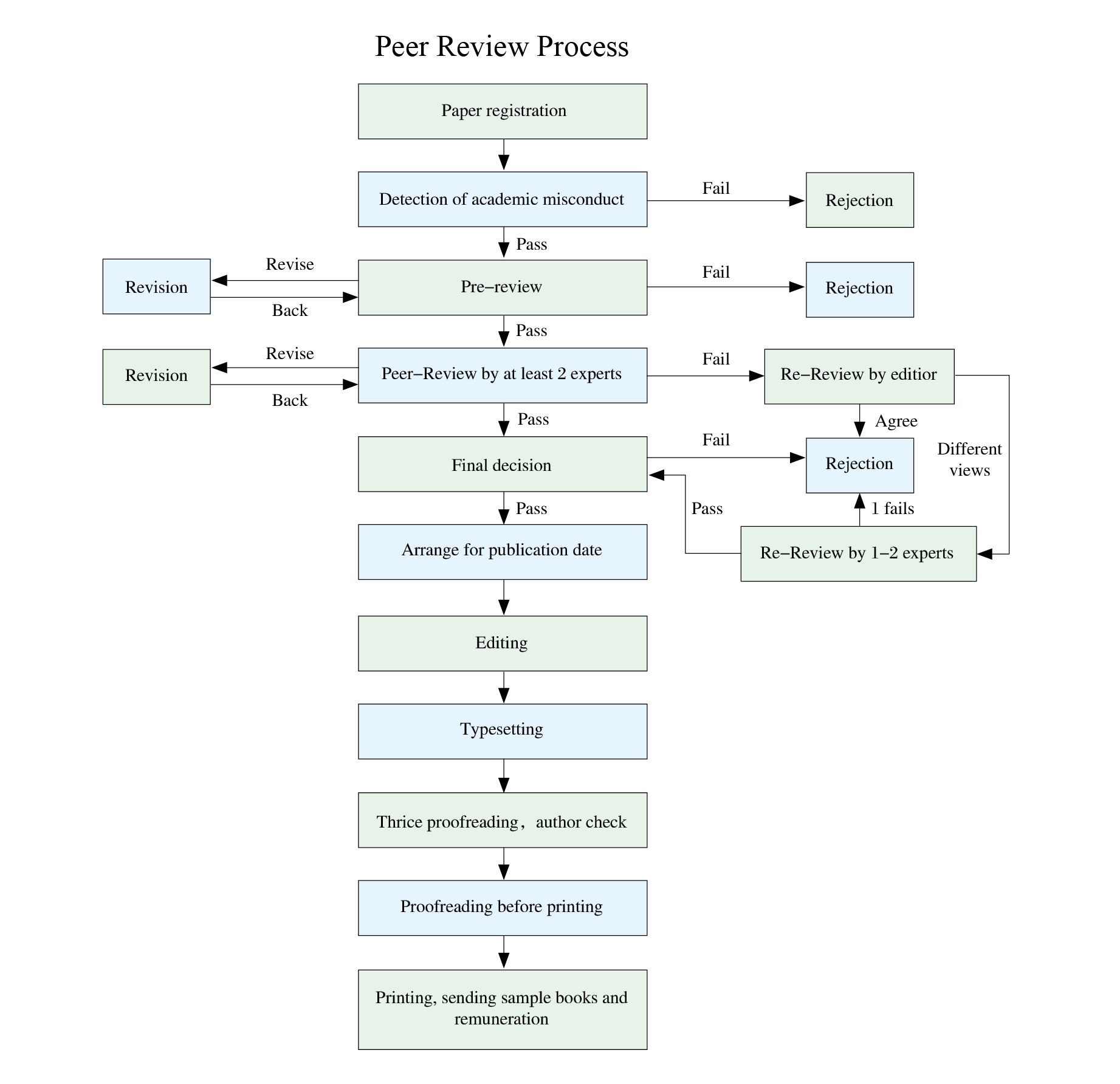
Peer Review Process

1. Submission. Upon receiving a submission, the editorial office registers the manuscript and sends a receipt to the corresponding author, providing the manuscript ID and account information for logging into the website to track the manuscript status.

2. Initial Review. If a manuscript exhibits any of the following issues, it will be rejected or recommended for submission to another journal: Inconsistent with the journal’s aims and scope; Lacking novelty or merely repeating previous research; Overlap with other submitted manuscripts in content, with an excessive number of similar submissions; Vague viewpoints, poor logic, or low readability; A total text similarity rate exceeding 10% as detected in academic misconduct screening; Obvious flaws in experimental or theoretical research, insufficient data, or evident errors in figures or tables.

3. Peer Review. The editorial office sends the manuscript to two external reviewers for double-blind peer review. The evaluation covers the manuscript’s originality, academic quality, and rigor. Reviewers are required to submit their comments. For statistical issues in the manuscript, the editorial office also assigns a statistical editor for review. The external review period is generally 21 working days. If the reviewers’ opinions differ, a third reviewer will be invited. If two or more reviewers recommend “rejection,” the manuscript will be rejected. Manuscripts passing the peer review proceed to the final review stage.

4. Final Decision by Editor-in-Chief. The Editor-in-Chief of the editorial office conducts the final review of manuscripts that have passed the external review on a regular basis. The handling editor submits the manuscript, along with the initial review comments and peer review feedback, to the Editor-in-Chief. After considering the manuscript content, initial review comments, and peer review opinions, the Editor-in-Chief decides whether to accept the manuscript. The final decision is then returned to the handling editor for further processing.

cfd87dd1eb2b77642e07c59e6035f586.jpg

Review Comments Policy

1. The outcomes of manuscript review fall into four categories: Acceptance/Revision and Acceptance/Revision and Re-review/Rejection.

2. The journal encourages diverse academic perspectives on manuscripts. The editorial department adheres to the principles of objectivity and fairness in handling review comments, ensuring that manuscript quality is evaluated based on academic standards without being influenced by factors such as political views, gender, or region.

Ethical Requirements

1. Editors, editorial board members, and reviewers should ensure that the peer review process is fair, impartial, and timely.

2. The journal employs a double-blind review process. Editors should avoid selecting editorial board members with conflicts of interest to review manuscripts, and editorial board members should avoid selecting peer reviewers with conflicts of interest to participate in the peer review process.

TOP